Play Therapy &
Creative Arts
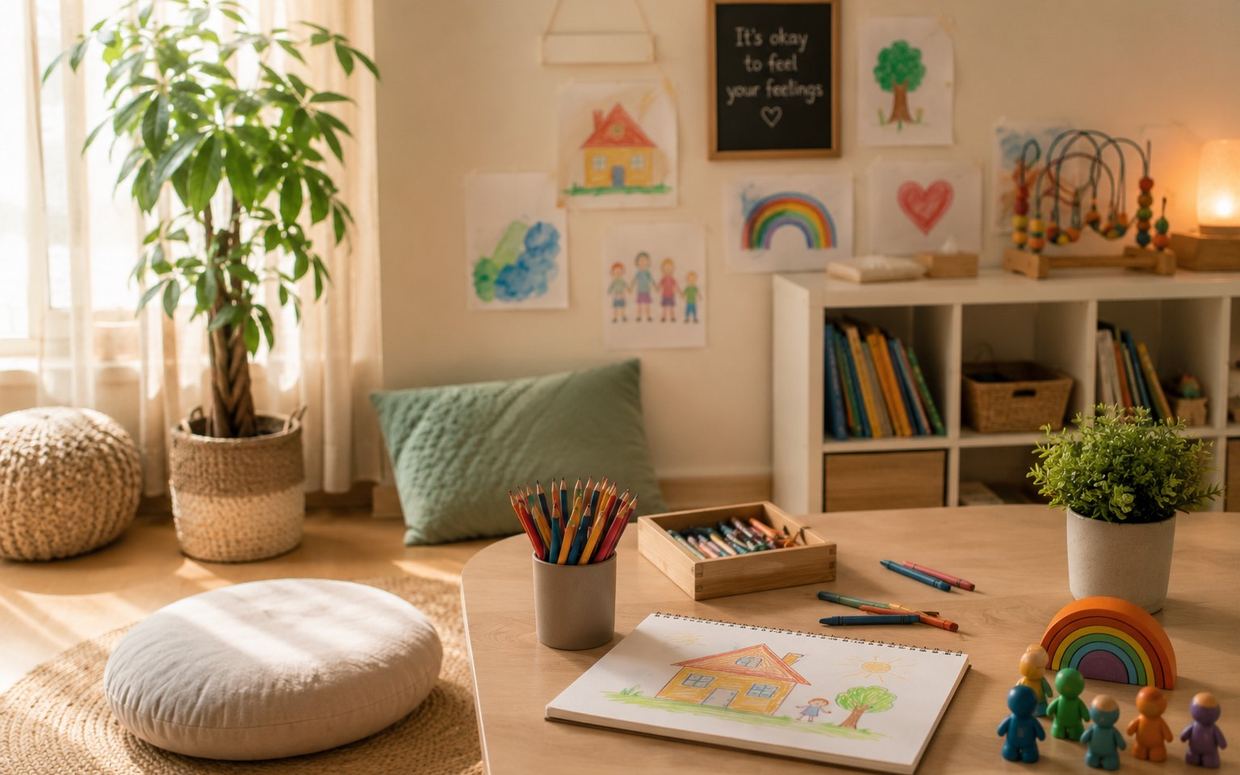
Play is a child's language and toys are its words. In play therapy, play is not a break from the work — it is the work. And it is not only play: these are symbolic techniques, and they reach where words do not.
Why play
A frightened child will not say "I have felt insecure since we moved house". But it will build a house out of blocks and knock it down, again and again. Symbolic play is how the human psyche processes before it finds words — and it remains available long after childhood.
The distance of the symbol is the key. It is far safer to talk about the bear who is afraid of the dark than about yourself; and through the bear, in the end, the same fear gets worked through. The child always controls how close it comes.
Not "just playing"
Play therapy does not stop at play. At its core are symbolic techniques — the symbol, the figure, the image, the role, the story — through which material that has not yet found words can be worked with.
That is precisely their value: a person can work through deep material at a subconscious and unconscious level, without having to put it into words. The understanding of what happens there rests largely on the psychoanalytic tradition, from which play therapy takes its theory of the symbol and the unconscious.
So this is not a method "for small children who play". It is a process with depth — and it works with teenagers and with adults too, when words alone have reached their limit.
What it involves
- Symbolic play, non-directive and directive — with figures, dolls, construction, board games that work on taking turns, losing and cooperating. Most of it is led by the child; directive work comes in deliberately, where it is needed.
- Art materials — drawing, clay, collage. The hand often arrives before speech.
- Storytelling and story-making — therapeutic tales, stories the child continues or whose ending it changes.
- Dramatisation and roles — trying out different positions within a scene: what would happen if I answered differently.
- Expression and regulation techniques — recognising feelings, settling the body, putting tension onto paper instead of into an outburst.
When it helps most
- When a child will not talk about what happened — or insists that "nothing is wrong".
- After a traumatic or stressful event: an accident, a loss, a separation, a hospital stay.
- In difficulties regulating anger, where talking alone is not enough.
- With children who have speech or communication difficulties.
- With teenagers and adults who "know everything" about their problem and yet nothing changes.
At a glance
- ForChildren and teenagers; selectively, adults too
- Duration50 minutes per session
- SettingAt the practice in Ilioupoli, or online
- AppointmentsBy phone or through the contact form
- TrainingPlay Therapy & Creative Arts, Metropolitan College
Frequently asked questions
The materials adapt. There is no one "right" medium: some children connect through construction, others through stories, others through board games, others through movement. The first sessions are spent finding exactly that.
No. Creative activities aim at skill and enjoyment. Play therapy has a therapeutic aim, is carried out by a trained mental health professional, within a stable framework and with a specific direction that follows from the therapeutic request.
Yes, selectively. Creative and expressive techniques are often useful with adults who understand their difficulty intellectually but find that nothing shifts — the symbol reaches where explanation has stopped working.
Through what changes outside the room: sleep, school, relationships, the frequency of outbursts. The play itself also changes — themes that were repeated compulsively begin to resolve, and that is visible.